DISCOVERY / Portable Sailing & Inflatable Structures
A sailing boat in two bags.
Tiwal changes a less glamorous part of sailing: storing and moving the boat. An inflatable hull and dismantling frame make access to the water part of the design problem.
Published 21 October 2026 · WHV · Public-source editorial note
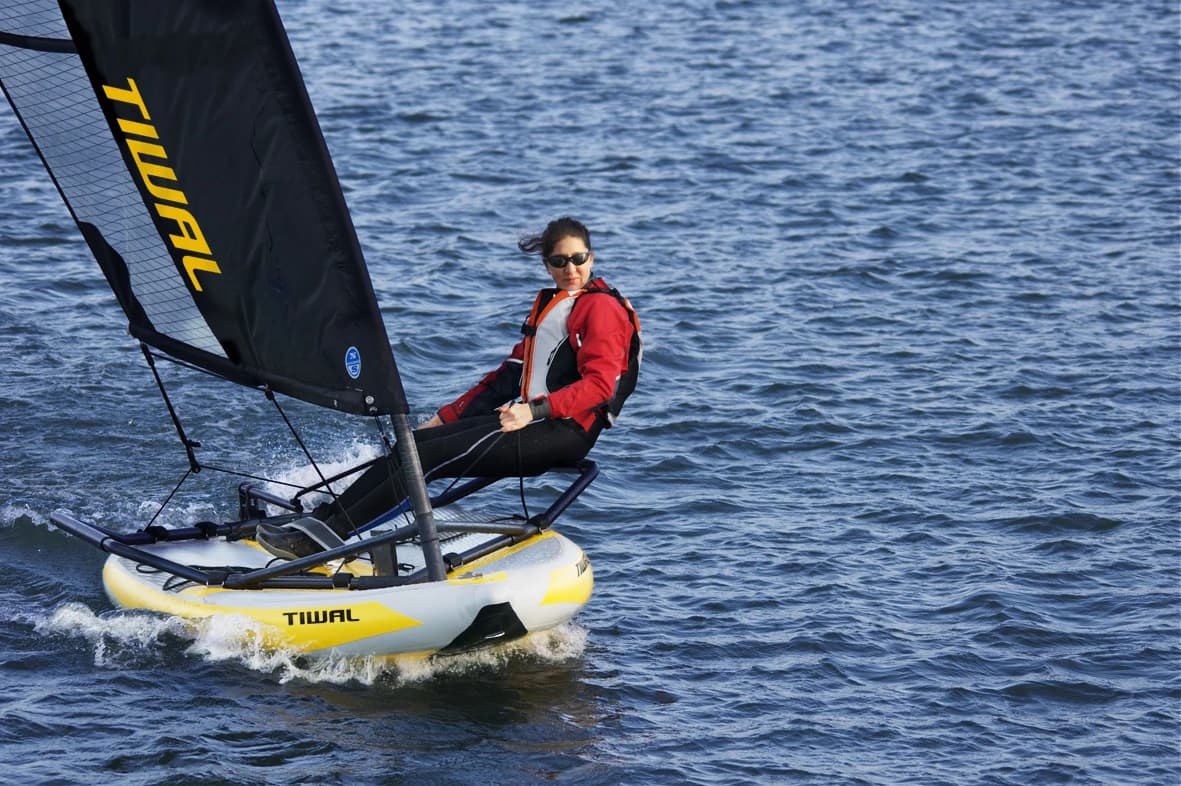
A sailing boat spends much of its life waiting. It needs somewhere to stay, a way to reach the water and someone willing to organise both. Marion Excoffon’s Tiwal treats those apparently secondary problems as central. The boat shown here is an early Tiwal 3.2, with the designer on the water. Its descendant continues the same practical argument.
Design the days when it is not sailing
The current Tiwal 3 combines an inflatable hull with an aluminium frame and a boomless sail. It dismantles into two bags rather than requiring a permanently assembled hull. This is not a claim that two bags are weightless or that every beach is a suitable launching site. It is a different relationship between a sailing boat and the space, transport and routines available to its owner.
That can matter more than a specification that only becomes useful on an exceptional day. A person with limited storage might use a portable boat more often than a larger craft that is difficult to reach. The design makes a potentially valuable connection between an enjoyable activity and the logistics that determine whether it actually happens. Accessibility here is physical and practical, not merely a lower price.
Portability is an invitation, not a qualification
Read the manual, check the operating category and choose conditions appropriate to training and local rules. Ask about sail options, inflation, repairs, rinsing and drying before packing. A portable boat still requires seamanship and care. Its enduring idea is modest and powerful: sometimes improving an experience means designing what happens before it begins and after it ends, not making the experience itself more extravagant.
Source and context.
Tiwal: current Tiwal 3 construction and two-bag transport ↗
Tiwal: owner manual, assembly and operating limits ↗
The archival photograph depicts the earlier Tiwal 3.2, not the current Tiwal 3 specification. WHV has not sailed or load-tested either boat. Follow the manual and local water-safety requirements.
Source checked 21 October 2026. WHV interpretation is distinct from the source’s account.
Explore Portable Sailing & Inflatable StructuresFOLLOW YOUR CURIOSITY
Where this leads.
Different subjects. A reason to connect them.

Continue the idea
The chassis is the character.
A different specialist vehicle makes its appeal intelligible through the experience it is designed to serve.
Lightweight Vehicles & Specialist Engineering
Read the story
Across the WHV world
The pattern that becomes the shape.
A garment gives another example of a flexible material becoming a useful three-dimensional structure.
Computational Textiles & Contemporary Dress
Read the story
An unexpected connection
The value of staying in class.
A traditional sailing class contrasts portability with the value of shared rules and a continuing community.
Small Sailing Boats & Class Communities
Read the story